Let’s start. The future won’t wait!
The Wennink Report is a wake-up call. Strategic Intelligence is how we turn ambition into execution.
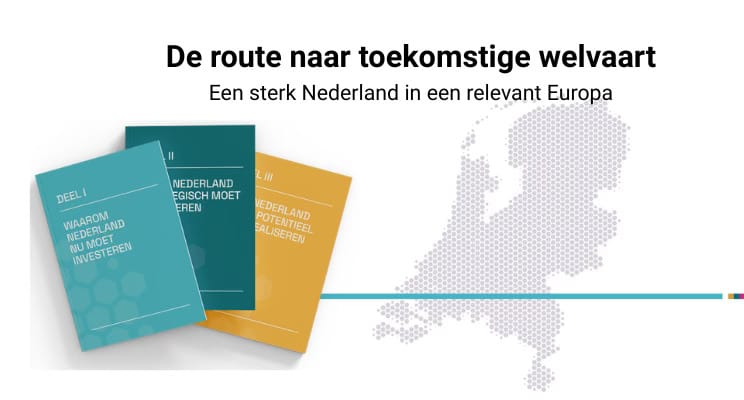
Last week I read the Wennink Report—an independent exploration written by Peter Wennink (former CEO of ASML)on how the Netherlands can retain and strengthen its international competitive position in technology and industry.
It was commissioned by the Dutch government in response to growing concerns about:
- Strategic autonomy
- Falling behind technologically
- A lack of long-term vision
And the core message is uncomfortable, but clear:
We’re not losing because we lack ideas. We’re losing because we can’t execute them at scale.
The key takeaways (and why they matter)
The report highlights several structural issues that many of us recognize—whether we work in government, industry, or the data world.
1) Economic growth is stagnating
The Netherlands has become less competitive in technology, innovation, and industry.
Not because we don’t have talent or strong companies.
But because we’ve lost focus on productivity growth.
2) Policy is fragmented
The current approach is spread across:
- Multiple ministries
- Institutions
- Government layers
With no central direction and no clear long-term goals.
That fragmentation doesn’t just slow things down.
It creates a system where nobody truly owns outcomes.
3) Strategic technologies aren’t supported enough
Critical domains, like AI, quantum, chips, or biotech, are not backed by the level of strategic policy and investment required.
In a world where the US and China move fast, “good intentions” are not a strategy.
4) Innovation policy is too subsidy-driven
The report argues that innovation policy is overly focused on:
- Subsidies
- Project applications
While companies need:
- Structural support
- Public-private collaboration
- Long-term investment
5) We have a structural shortage of technical talent
The labor market and education system are not set up for what’s coming.
This is not a short-term gap.
It’s a long-term constraint.
6) We’re too dependent on other countries
For critical technologies and industrial supply chains, the Netherlands is increasingly dependent on others.
That dependency is a risk.
And it limits strategic autonomy.
The Wennink dilemma: ambition vs. execution
The report proposes an ambitious agenda for economic recovery:
€151–187 billion of investment over the next 10 years across four strategic domains:
- Digitalization & AI
- Security & resilience
- Energy & climate technology
- Life sciences & biotechnology
But the report also points to the real bottleneck:
Execution.
Without an effective governance structure, decisiveness, and public-private coordination, this agenda will not succeed.
And that’s the part that matters most.
Because we can announce strategies for a decade.
But if we can’t measure progress, detect issues early, and course-correct quickly…we’re just writing documents.
Strategic Intelligence: the operational framework
This is where Strategic Intelligence comes in.
Not as “another BI tool with dashboards.”
But as an intelligence platform that helps decision-makers turn complex strategic ambitions into reality through:
- Real-time monitoring
- Signal detection
- Data-driven decision-making
In practice, Strategic Intelligence means:
- A single, shared view of progress
- Early warning signals when initiatives drift
- Objective measurement against strategic goals
- Faster intervention without bureaucracy
The report suggests an independent Commissioner for Future Prosperity.
Strategic Intelligence gives that role something essential:
The ability to act based on facts—fast.
Transparency for everyone (and less politics)
One of the most powerful ideas here is also the simplest:
Give everyone the same information.
If 30+ consortia, government agencies, and financial partners all work from the same objective data:
- Less fragmentation
- Less “political interpretation”
- More alignment
Just transparent, real-time monitoring of progress across the four domains.
The Bravinci Code: trust as the foundation
Execution is not only a technical problem.
It’s a trust problem.
Years of unstable policy have created a gap between:
- Ambition and credibility
- Plans and confidence
- promises and proof
Strategic Intelligence, supported by The Bravinci Code, is designed to rebuild that trust.
Not through bold statements.
But through transparent, real-time monitoring that shows what’s happening, what’s not, and what needs to change.
So what now?
If we want to compete, we need to stop treating execution like an afterthought.
We need:
- Clear ownership
- Shared metrics
- Real-time visibility
- The ability to intervene early
Let’s start. The future won’t wait.
If this resonates
- What do you see as the biggest blocker to execution in large public-private initiatives?
- Where do you think transparency would help most: funding, governance, or delivery?
If you want to talk about what Strategic Intelligence could look like in practice, reply here or message me.
And if you found this useful, consider sharing it with someone who’s involved in innovation policy, digital transformation, or public-private programs.
Consulting Partner at Bravinci. Snowflake Data Superhero and Chapter Lead for the Dutch Snowflake ❄️ User Group. Online also known as; DaAnalytics.